


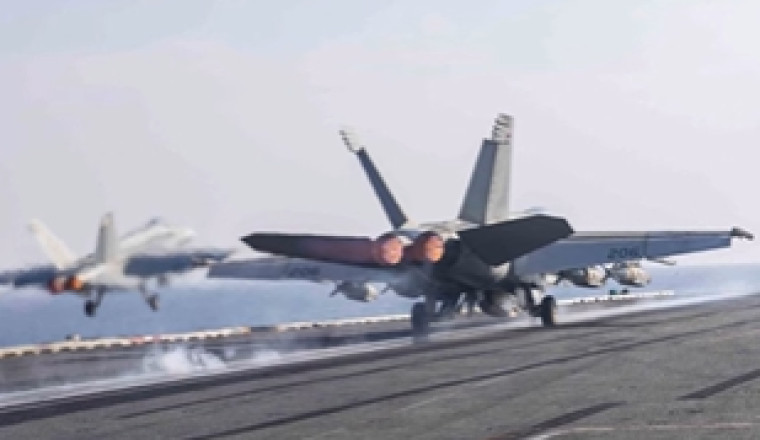
The United States is intensifying its air strikes and military operations against Islamist extremists in Somalia to mitigate the risk of jihadi attacks on American soil. These terrorists are primarily linked to either the Islamic State (ISIS) or al Qaeda. This information comes from U.S. Army Lt. Gen. John Brennan, the second highest-ranking official at U.S. Africa Command, who spoke exclusively to Fox News Digital last week.
Brennan, a former leader of U.S. Special Forces with experience in Iraq, Syria, and Afghanistan, stated, "There's ISIS-inspired threats. They plot against the United States homeland as well as Europe. So that's kind of the nexus of the threat." He continued, "American citizens on social media get recruited to do bad things inside America. And then there's ISIS lead and ISIS resource cells that are capable of larger-scale attacks. We've stopped, over the history since 9/11, a lot of those from happening, because of what we do overseas, so we're playing the away game."
He added, "When you give a terrorist organization that has resourcing like ISIS time and space to plot and plan, those ISIS and terrorist-led attacks can happen. If they're on the run, and they're constantly worried about surviving, they can't be as effective at planning and plotting." The U.S. is actively conducting strikes and utilizing intelligence resources in a robust campaign to dismantle the grip of terror in Somalia, aiming to prevent the nation from becoming what the State Department labeled in 2017 as "a terrorist safe haven".
In 2025, the U.S. Africa Command (AFRICOM), in collaboration with Somali and other allies, executed 124 airstrikes targeting ISIS-Somalia (Islamic State) and al-Shabab terrorist groups along with their infrastructures in Somalia. This figure is 12 times greater than the number of missions conducted during the Biden administration in 2024. In January 2026 alone, the U.S. has launched an additional 26 attacks, which is 2½ times more than the 10 strikes that occurred throughout 2024.
Brennan informed Fox News Digital that the center of Islamist terrorism has shifted from the Middle East to Africa, particularly Somalia. "The caliph — absolute leader — of the global ISIS network, Abdulqadir Mumin, is a Somali, and he is in the (Somali) Golis Mountains along with a lot of his key leaders. And from that location they direct terrorist activities, not just across Africa. He is directing global ISIS operations that go to the Far East, Europe and the U.S."
In February 2025, President Donald Trump addressed Somalia on his Truth Social account, stating, "The message to ISIS and all others who would attack Americans is that ‘WE WILL FIND YOU, AND WE WILL KILL YOU!’" When asked by Fox News Digital this week if U.S. forces are pursuing the ISIS leader Mumin, Brennan confirmed, "Yes, absolutely. We want to make sure he has no safe space anywhere. History has shown that the ISIS caliph ends up getting killed by us at some point."
"We’re on no. 4 right now," he continued, referencing the most infamous, Abu Bakr al-Baghdadi, who was tracked down in Syria. In Somalia, the Islamic State is represented by ISIS-Somalia. "We've had a lot of success targeting that network, ISIS-Somalia," he said. "We've taken large swathes of terrain back — our partners have. We've just enabled with intel sharing ISR (Intelligence, Surveillance, Reconnaissance) and fires — airstrikes. About well over half the territory that ISIS Somalia once maintained up in Puntland — an autonomous state in North-Eastern Somalia — is now under the control of the Puntland Defense Forces."
"They've conducted a massive amount of clearing operations, taking back terrain, capturing a great number of ISIS operatives, as well as a lot of their material. But again, our main mission is to secure the homeland — make sure that none of this threat migrates back to our shores. I think we've been pretty successful at that and if the PDF can continue what they're doing, ISIS Somalia may cease to exist before too long. That's our ultimate goal," he remarked.
On the other hand, Al-Shabab, the local al Qaeda affiliate, continues to pose a challenge in Somalia. He noted, "In the south you have al-Shabab, and that threat has definitely morphed over the last year or so, as they are coordinating with the Houthis." "Not as much (an) external operations threat," the general continued, "but in fact, al-Shabab is, I think, the strongest, largest, most well financed part of the al Qaeda global franchise and their desire is to take over Mogadishu and turn Somalia into an al Qaeda caliphate."
The U.S. involvement in Somalia in 2026 is increasingly characterized by "remote advise and assist," with the majority of Somali troops utilizing their own ground assault vehicles, Brennan explained, adding that occasionally they offer them "with a ride to work" — transporting them to raids via U.S. helicopters and providing airstrike support. AFRICOM supplies advanced intelligence capabilities. Brennan stated, "We've given them tools that allow them to see what the ISR aircraft are seeing. We can show them things on a moving map that they're carrying on their chest."
Ambassador Robert Scott, a seasoned diplomat who joined the State Department in 2023 as the deputy to the commander for civil-military engagement with AFRICOM, shared with Fox News Digital that various governments surrounding Somalia have successfully collaborated with AFRICOM. He noted, "not only Kenya and Ethiopia and Uganda, but also Somaliland, Puntland especially (and) also Jubaland. So (we are) finding partners who are willing to engage in the fight against both ISIS and al Shabab. I think it's been very effective."
Brennan further emphasized that U.S. military operations in Somalia could unlock significant trade opportunities. He remarked, ""There's natural resources in Somalia that, because of the security situation, the Somalis have not benefited from," he added. "Now the Somalis are realizing they may have critical minerals." "There's LNG (liquified natural gas) off the coast of Mogadishu, so that our biggest weapon system, if you will, from an African perspective, is our private sector economy. If we can get that in there with private sector investment similar to other countries in Africa, that is a guarantor of security."






Comments
0 comment